Here is something you couldn't do before.
Ask the whole book.
Your models. Your research. Your team's investment history.
IRIS is the investment context layer for Claude. It grounds analysis in financial models and their underlying evidence, preserves your firm's accumulated investment research and reasoning, and makes that knowledge available across the entire book—in claude.ai and Claude for Excel.
See how IRIS works · Browse the models · Ask the whole book: six models, one question
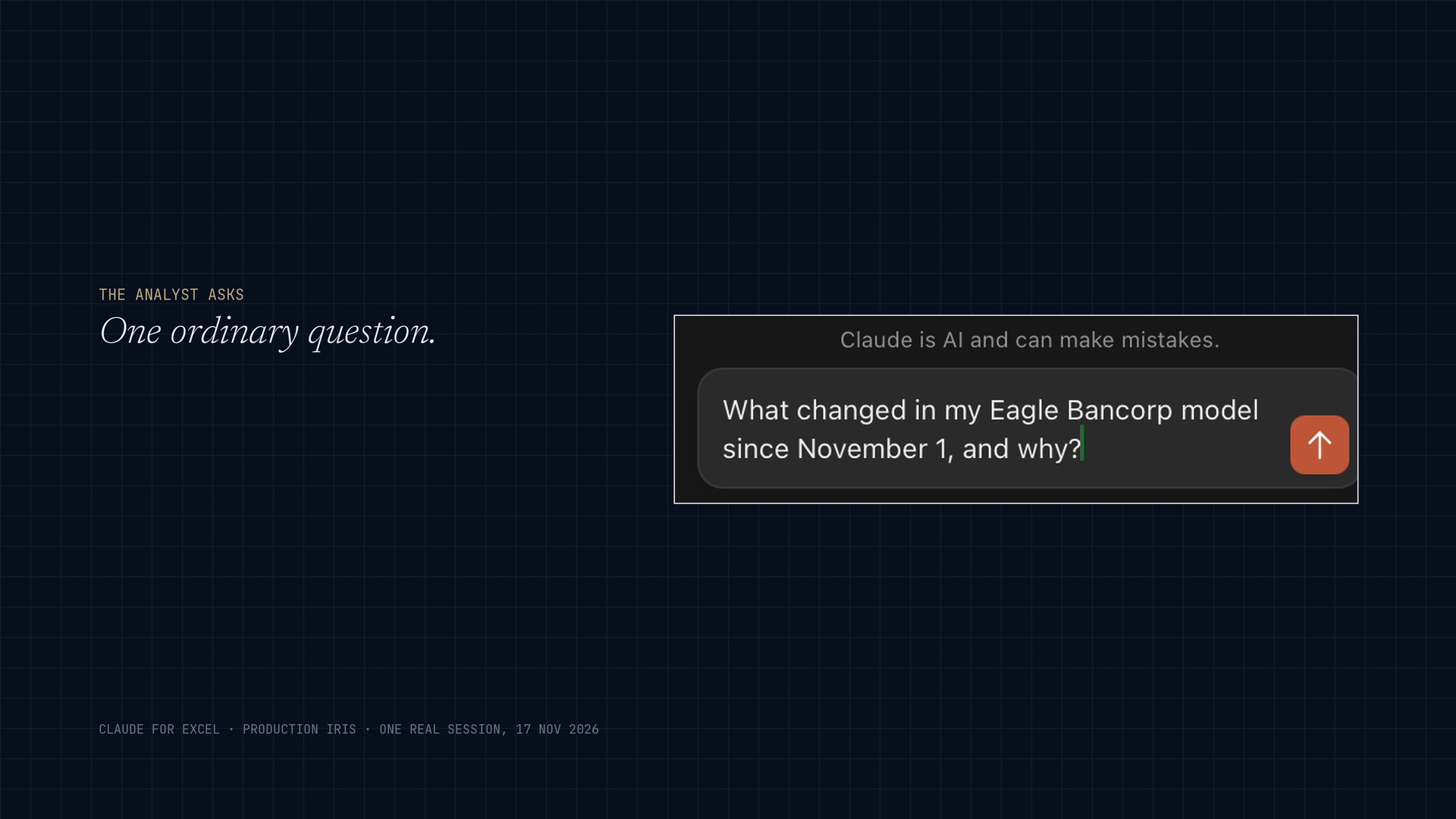
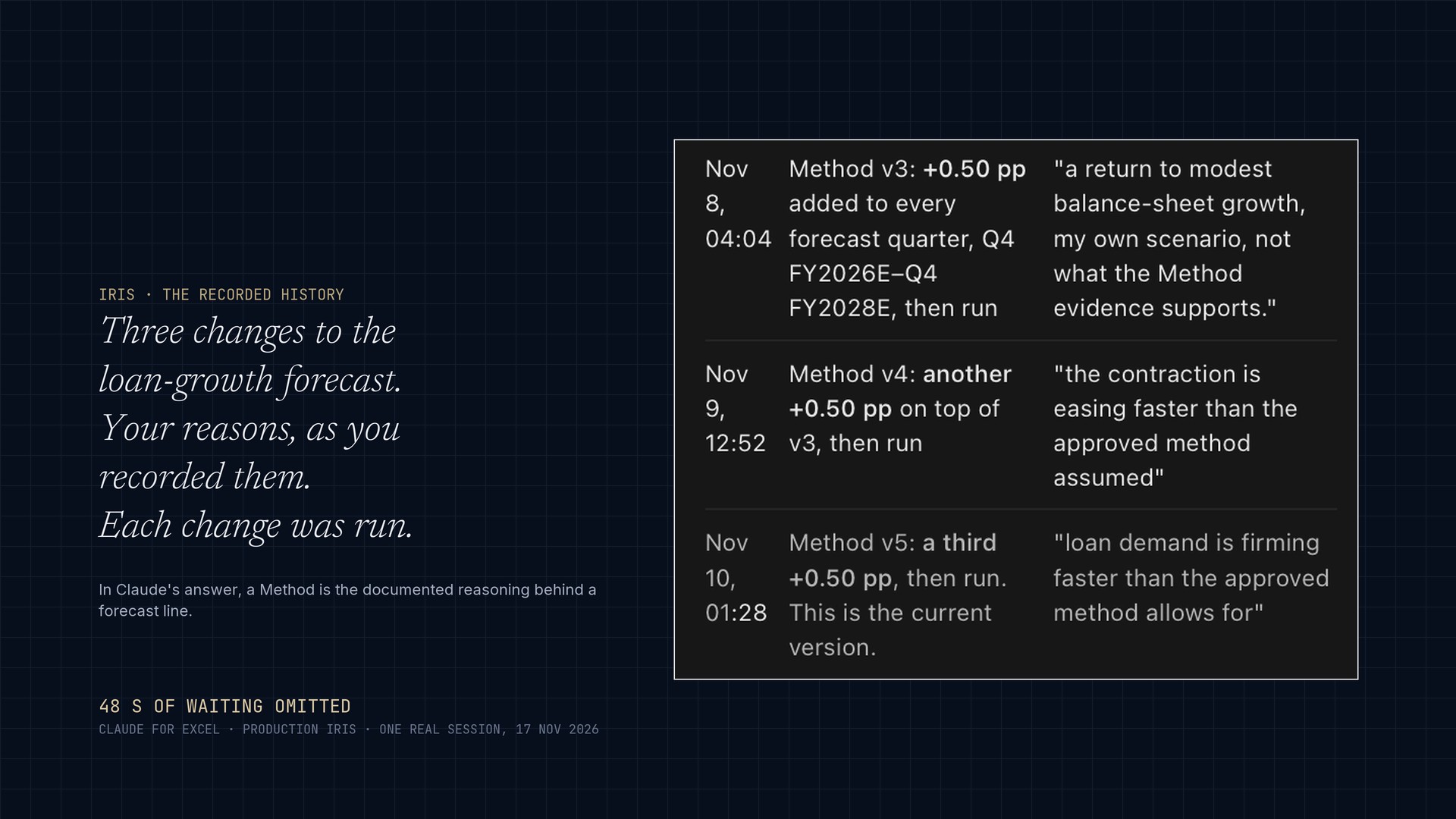
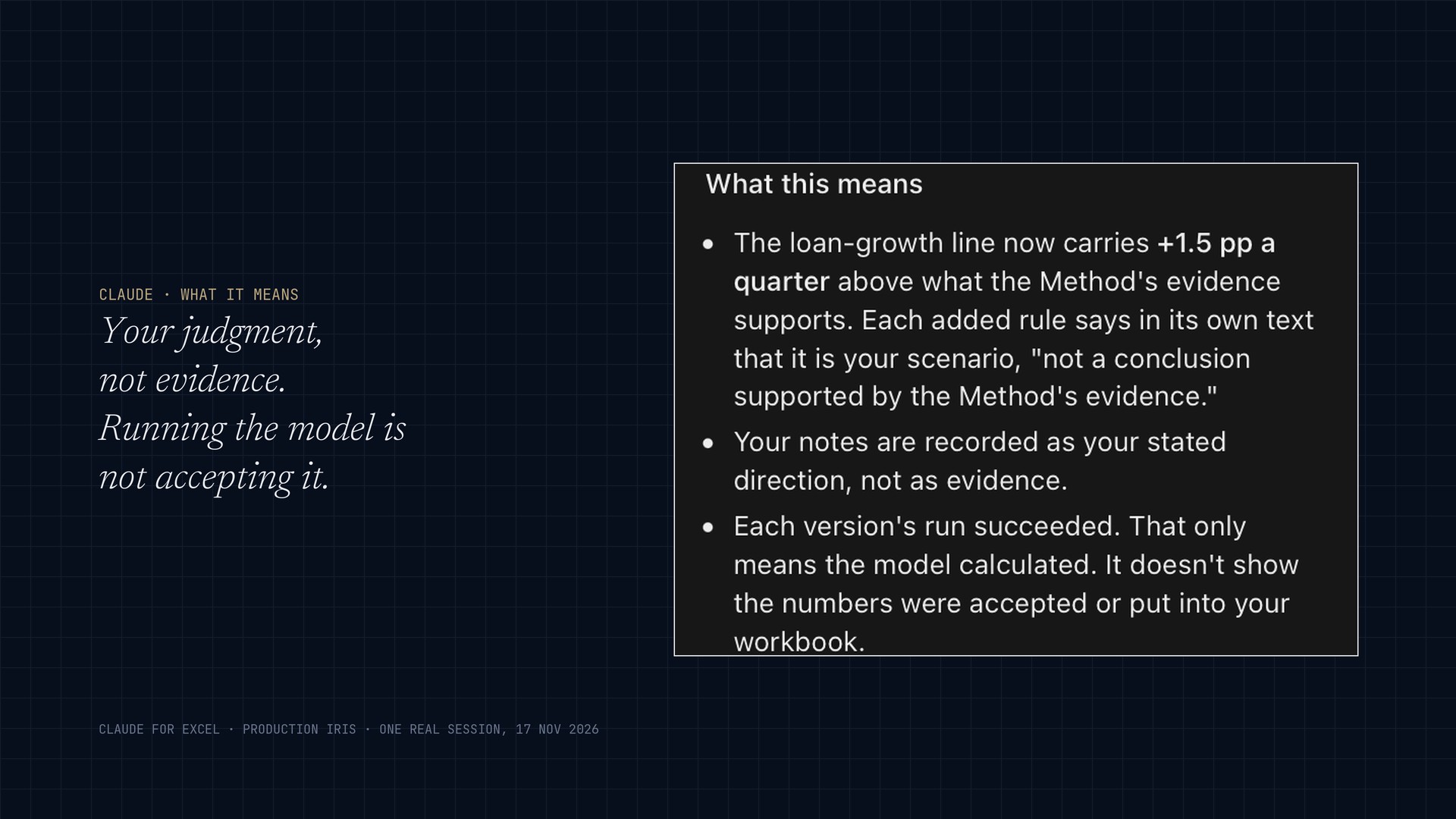
Models that remember why.
A company forecast in Excel. The reasoning behind each line. Everything you decided, there when you return.

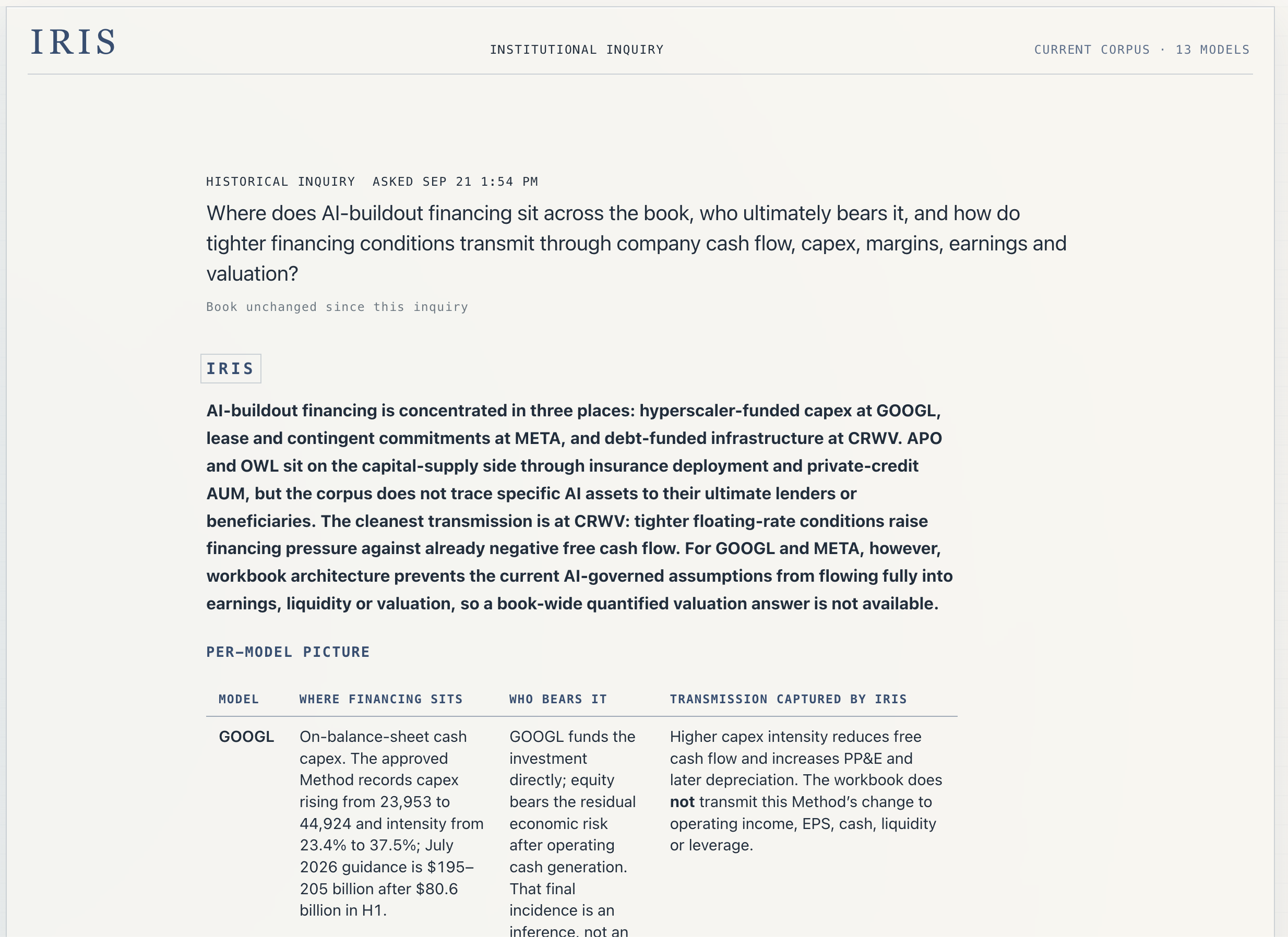
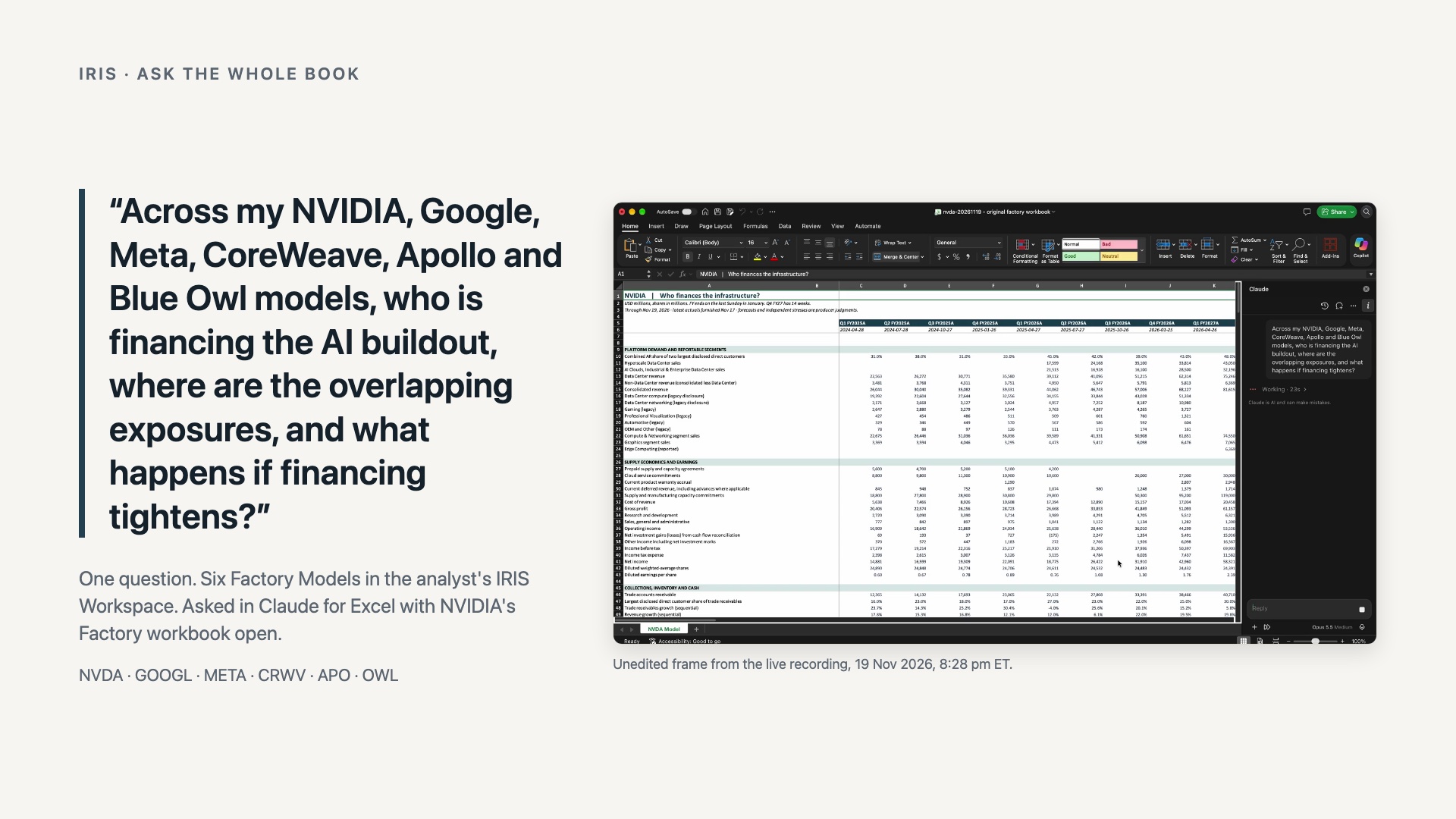
Six models, one question.
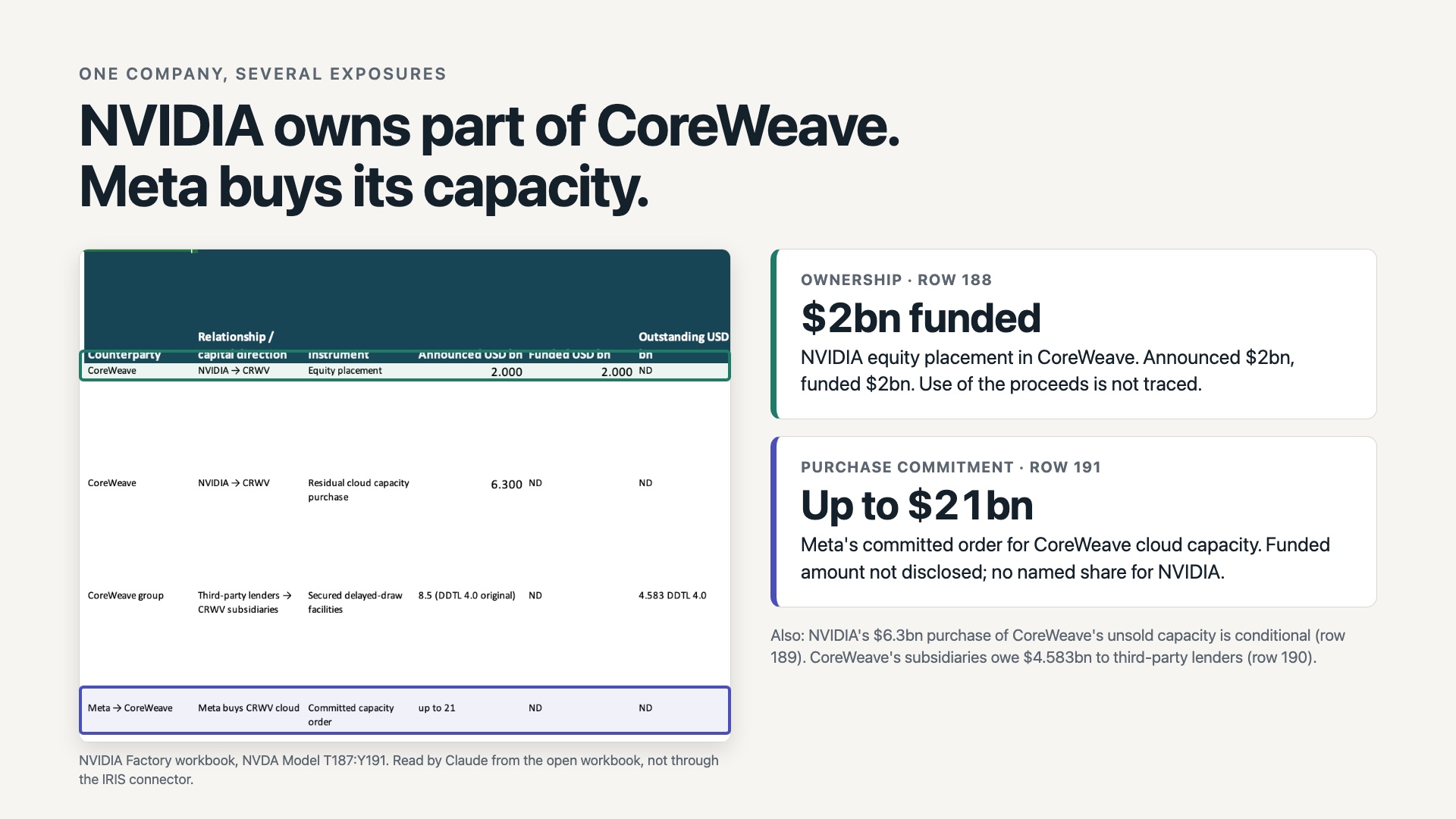
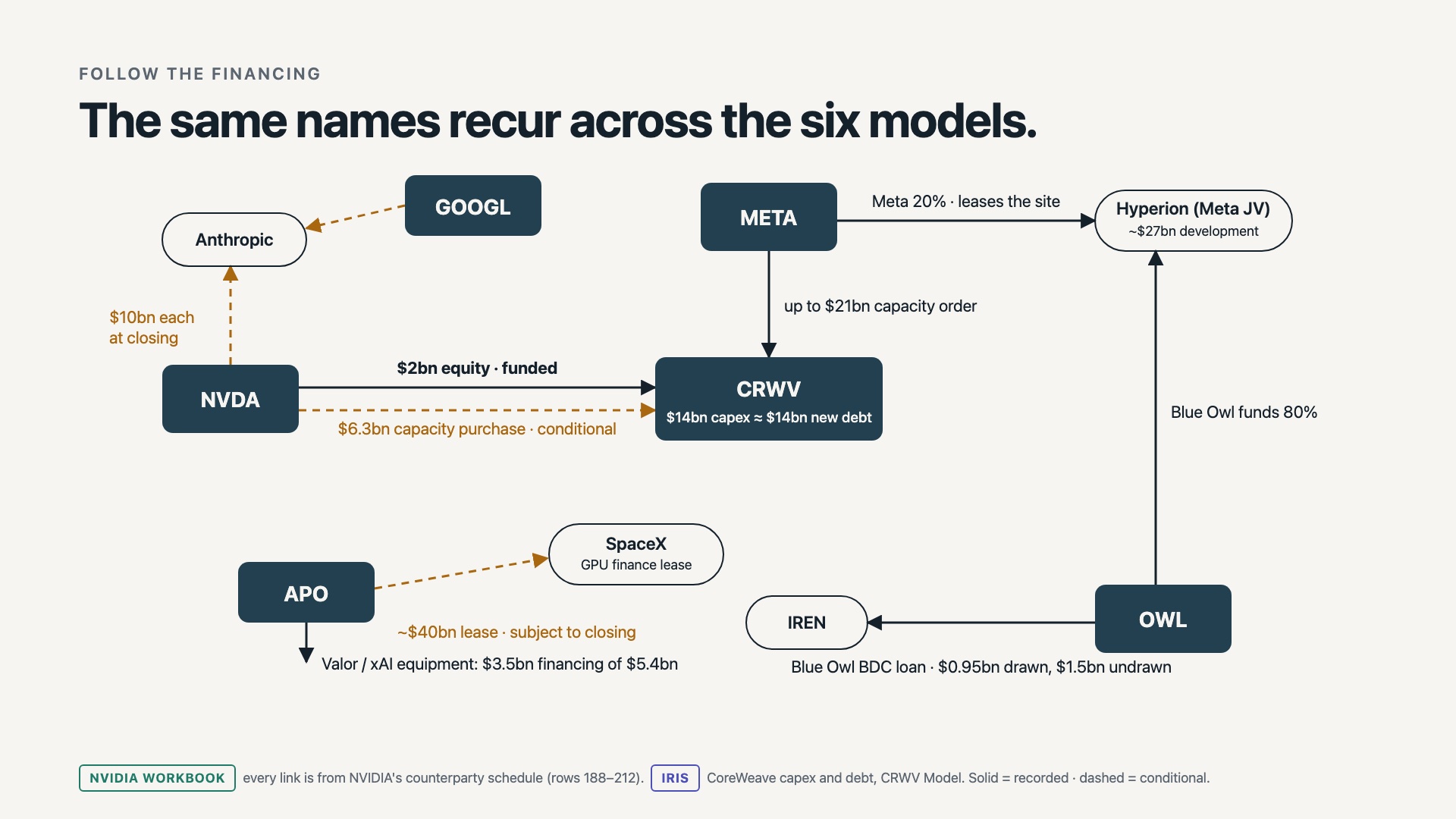
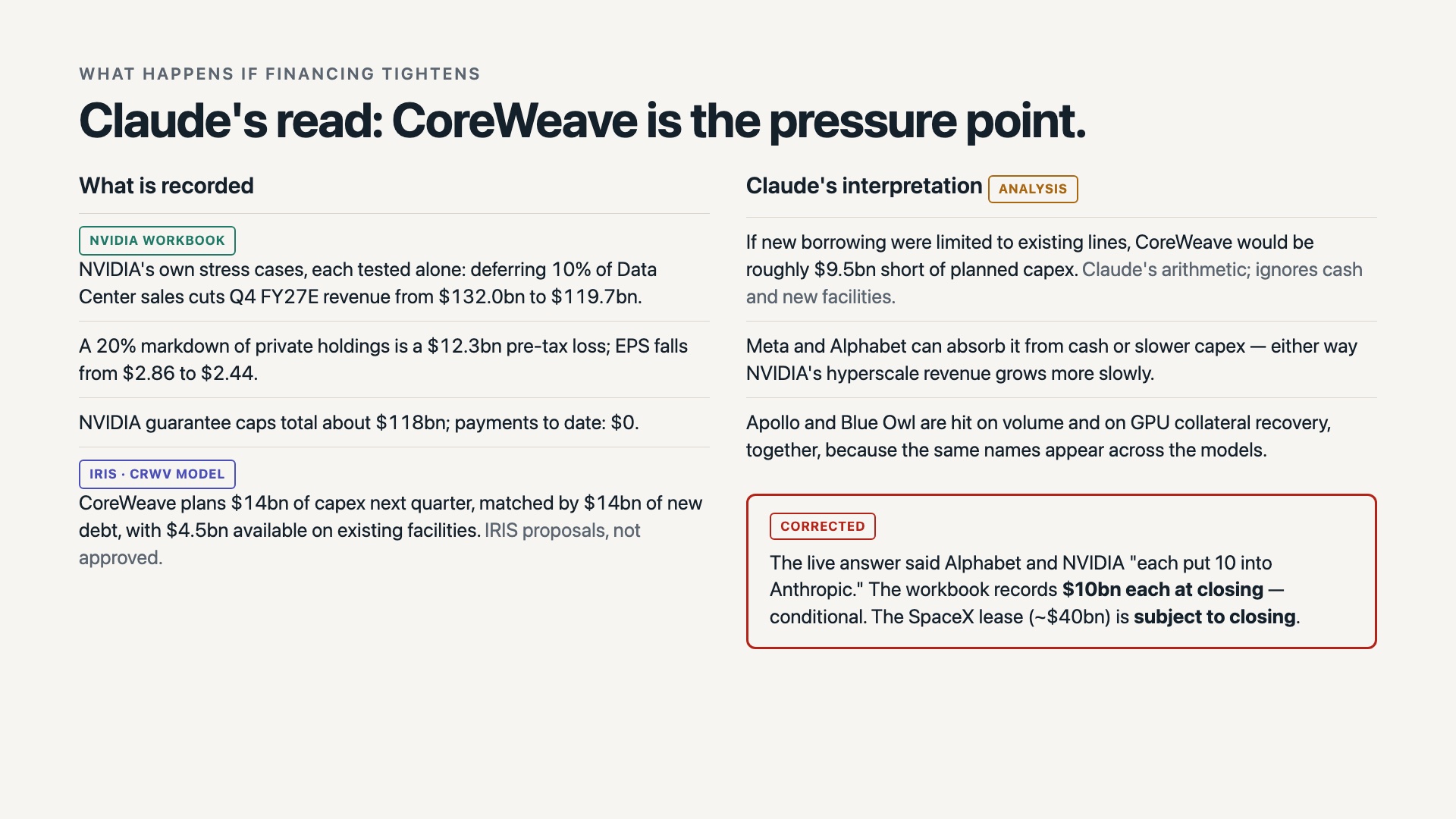
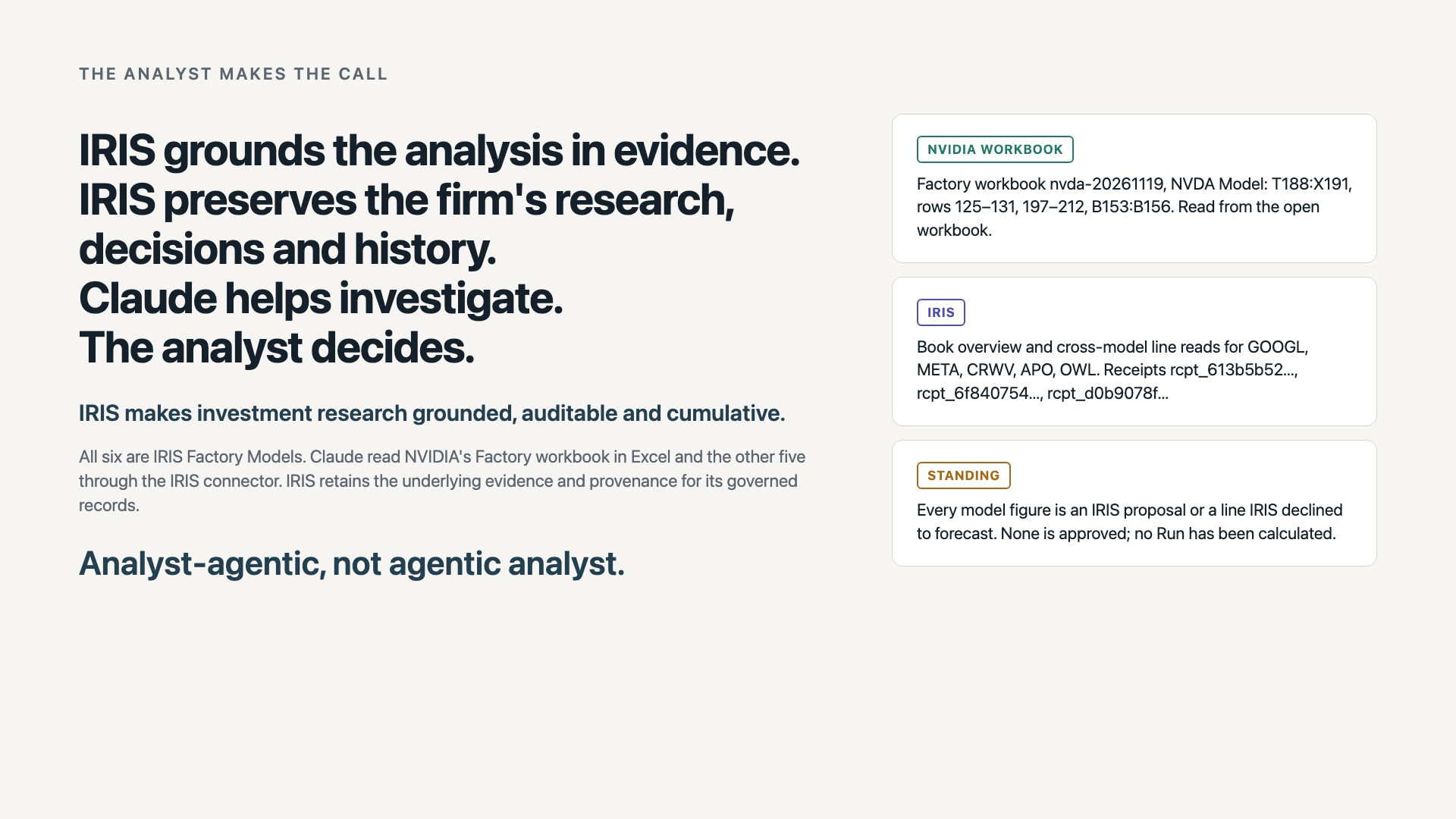
One question across six company models: who is financing the AI buildout, where the exposures overlap, and what happens if financing tightens. NVIDIA's workbook open in Excel, five more models through IRIS, Claude's reading marked as interpretation.
What if?
Test the assumption. Keep the forecast.
Ask Claude what happens when growth slows, credit losses rise, or margins compress. IRIS calculates the alternative, compares the financial consequences, and preserves the experiment without changing your approved forecast.
The analyst chooses the assumption and approves the calculation. Claude helps investigate. IRIS keeps the evidence and results.
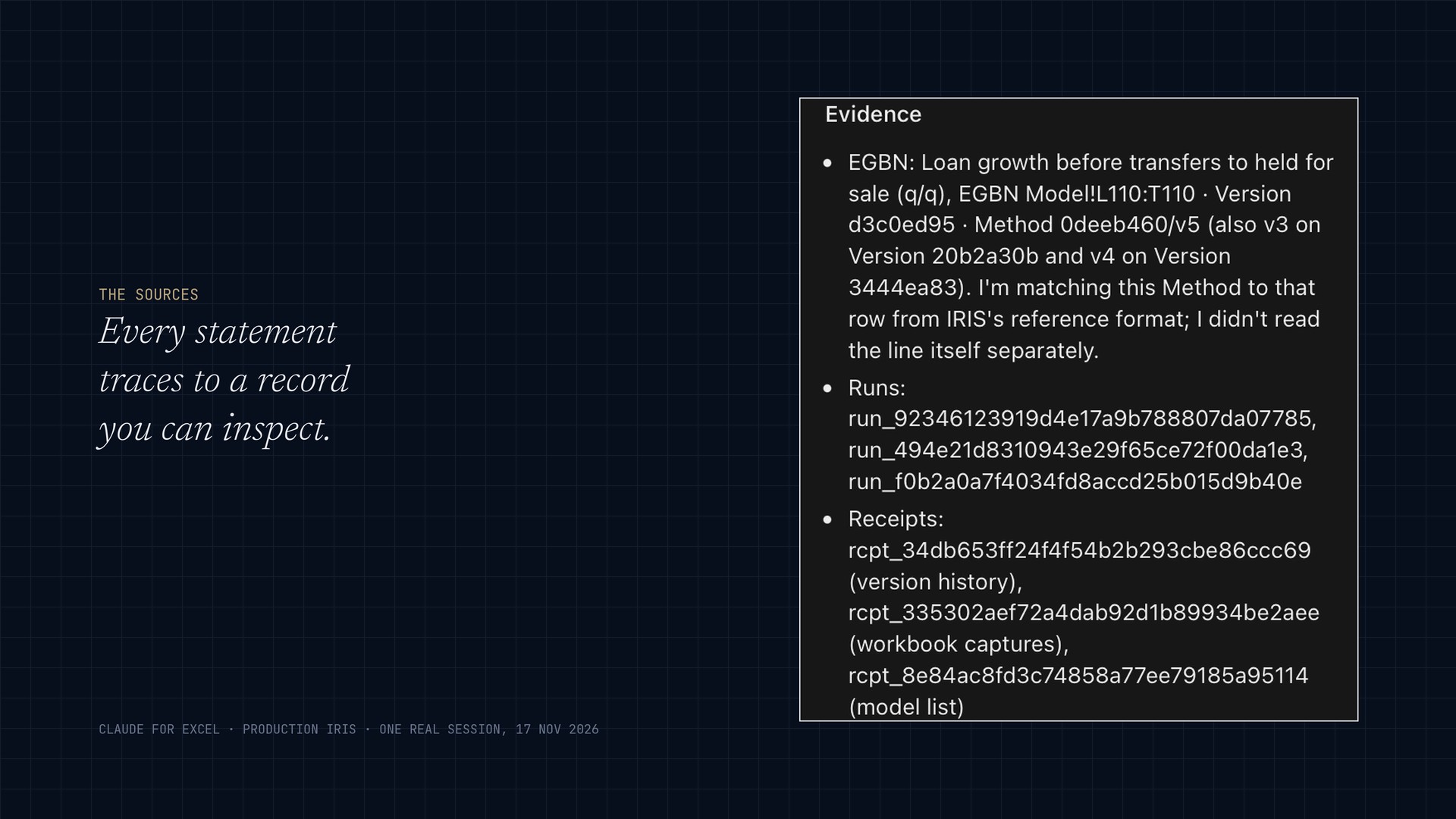
EGBN · observed what-if
What if gross charge-offs rise 20 basis points?
- Q4 FY2026E diluted EPS
- −$0.098 → −$0.181
- CET1 ratio
- −3 to −6 bp
- Operative forecast
- Unchanged
Eagle Bancorp's ordinary gross charge-off rate raised from 0.82% to 1.02% for Q4 FY2026E and Q1 FY2027E. Asked in Claude for Excel in November 2026; IRIS ran a paired baseline and alternative on the same model Version. These are the recorded calculations, not illustrative figures.
Analyst-agentic, not agentic analyst.
Claude owns the horizontal intelligence. IRIS owns the vertical context.
The analyst owns the judgment. Claude helps investigate. IRIS preserves the research.
Our quality standard
| Dimension | Acceptance standard |
|---|---|
| Investment usefulness | Would we actually use the answer as portfolio managers? |
| Financial accuracy | Calculations reconcile to the Models |
| Economic sophistication | Understands business mechanisms, not merely correlations |
| Presentation | Economics first, system mechanics only when relevant |
| Evidence | Accessible, readable and reproducible |
| Responsiveness | Feels like a natural research conversation |
| Excel | Numbers and assumptions are easy to inspect |
| Analyst agency | No unintended changes to forecasts |
| Flexibility | Works beyond anticipated questions |